

Introduction
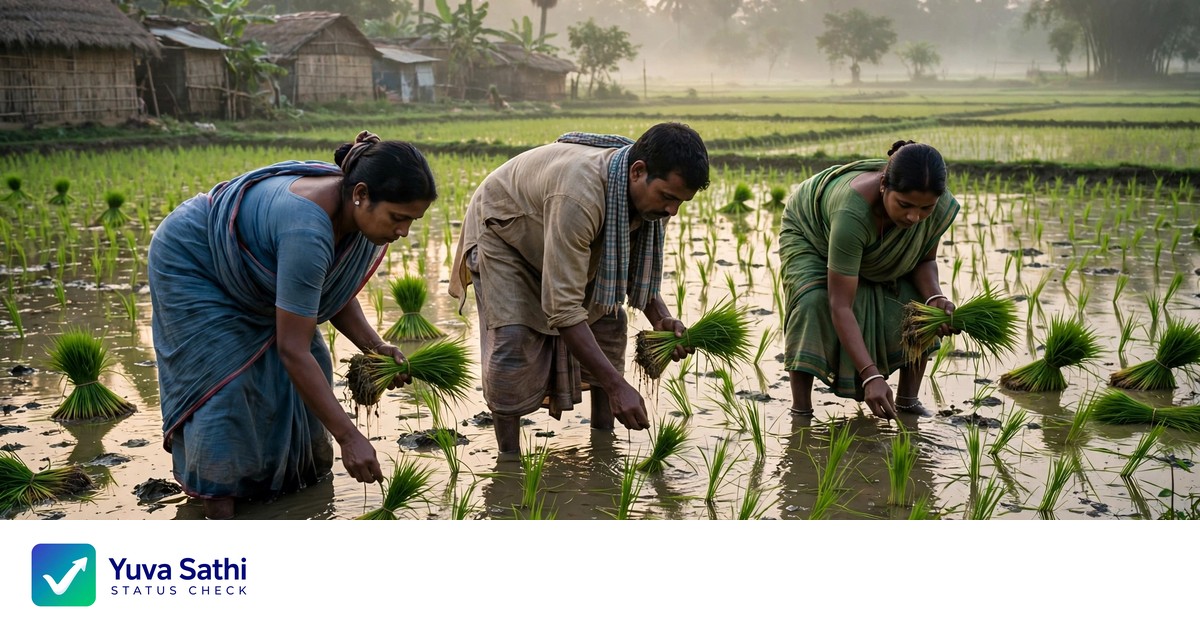
West Bengal’s flagship farmer welfare programme reaches lakhs of cultivators — but it has one built-in blind spot. To qualify for Krishak Bandhu, you need your name in the land records. That single condition quietly excludes the very people who do the hardest physical work in the fields: the landless agricultural labourers who plant, weed, and harvest on someone else’s land for daily wages. The bhumihin krishak bandhu scheme — officially registered on the government portal under the name Bhumihin Khet Mazdur — was created to close exactly this gap. It offers direct yearly financial support to landless farm workers who own no cultivable land of their own.
This guide explains the scheme in plain language: what it offers, who qualifies, which documents to keep ready, how the application process works, and how to track your status once you have applied. Wherever a detail is still being clarified by the authorities, that is stated openly, so you can tell announced facts apart from speculation.
Bhumihin Krishak Bandhu at a Glance
| Detail | Information |
|---|---|
| Scheme name | Bhumihin Krishak Bandhu (registered as Bhumihin Khet Mazdur) |
| Meaning | Support for landless agricultural labourers (“bhumihin” = landless) |
| State | West Bengal |
| Target group | Landless agricultural labourers with no cultivable land of their own |
| Annual assistance | ₹4,000 per year (announced) |
| Payment structure | Two instalments of ₹2,000 each, aligned with the Rabi and Kharif seasons |
| Payment mode | Direct Benefit Transfer (DBT) to the beneficiary’s bank account |
| Application mode | Offline camps and the official state agriculture portal |
| Status tracking | Through the official portal’s beneficiary status section |
Please treat the figures above as announced. Final, binding details always come from the government’s official notification, and amounts or timelines can be revised.
Why Landless Labourers Needed a Separate Scheme
Krishak Bandhu is designed around land ownership. Its verification starts — and usually ends — with the Record of Rights: if your name appears as a landowner or a registered sharecropper (bargadar), you are in; if it does not, the door stays shut. That logic works for cultivators, but it leaves out an enormous workforce. Across West Bengal, lakhs of men and women earn their entire livelihood as agricultural labourers without owning a single decimal of farmland. They sow and reap on other people’s fields, paid by the day or by the task, with no land document to show at a verification counter.
These workers face the same seasonal uncertainties as farmers — failed monsoons, pest attacks, and lean months between harvests — but without the safety net that land-linked schemes provide. A bad season hits them first and hardest, because when there is no crop to harvest, there is no daily wage either. The bhumihin krishak bandhu programme recognises this reality. Instead of asking for land papers the applicant cannot possibly produce, it is built around the worker’s actual occupation: depending on agricultural labour for a living.
Key Benefits of the Scheme
The centrepiece of the scheme is straightforward cash support, paid directly and without middlemen:
- ₹4,000 per year in financial assistance for each eligible landless agricultural labourer, as announced.
- The amount is split into two instalments of ₹2,000, timed around the Rabi and Kharif cropping seasons — the two points in the year when farming households face the heaviest expenses and the greatest income uncertainty.
- Money is transferred through Direct Benefit Transfer straight into the beneficiary’s own bank account. There is no cash handling at any office, which removes the most common source of leakage and delay.
- Because the support is linked to the agricultural calendar rather than a one-time event, it functions as a small but predictable seasonal cushion that families can plan around.
It is worth keeping expectations honest: ₹4,000 a year will not transform a household’s finances. What it does is put a dependable, documented payment into the hands of workers who have historically received nothing from land-linked welfare — and it does so through the same DBT rails that carry the state’s larger schemes.
Who Is Eligible?
Based on the announced framework, an applicant is expected to qualify if all of the following conditions are met:
- Permanent resident of West Bengal. The scheme is a state programme, and domicile in West Bengal is the first condition.
- Genuinely landless. The applicant must not own cultivable agricultural land in their own name. This is the defining condition of the scheme — it exists precisely for those whom land records exclude.
- Dependent on agricultural labour. The applicant’s primary livelihood should come from working as an agricultural labourer — sowing, transplanting, weeding, harvesting, or similar farm work on others’ land.
- Not a registered sharecropper (bargadar). Sharecroppers with valid documentation are generally covered under Krishak Bandhu instead, so the two schemes are not meant to overlap.
- Not already enrolled in Krishak Bandhu (Natun). The landless-labourer scheme is a parallel track, not an add-on. Applicants already receiving Krishak Bandhu benefits are expected to be ineligible here.
- Adult applicant. Applicants are generally expected to be 18 years or older.
- Own bank account, Aadhaar-linked. Since payments travel by DBT, the applicant needs a bank account in their own name, seeded with Aadhaar in the NPCI mapper. An account that is merely “linked” in the bank’s own records is not enough — the NPCI seeding is what makes DBT work.
Because the complete official rulebook had not been published at the time of writing, treat these conditions as the announced framework. The final notification may clarify or adjust them, so confirm the exact criteria at your local block office before applying.
Documents You Should Keep Ready
Gathering paperwork in advance is the single best way to avoid a rejected or delayed application. Based on how comparable West Bengal welfare schemes handle enrolment, keep the following ready:
- Aadhaar card — the primary identity document, and the key to DBT verification.
- Voter ID (EPIC) or another residence proof — to establish West Bengal domicile.
- Ration card, if available — useful for household verification.
- Bank passbook (first page) — showing your name, account number, and IFSC code. Confirm at your branch that the account is Aadhaar-seeded for DBT, not merely KYC-updated.
- Proof of agricultural labour work, if available — any document that shows you work as a farm labourer, such as registration with the local labour office or a certificate from the panchayat. If you have nothing in writing, ask at the camp what the local office accepts.
- Recent passport-size photograph.
- Active mobile number — needed for OTP verification and status updates.
A practical tip: get your bank account’s DBT status checked before you apply, not after. Visit your branch, ask specifically for Aadhaar seeding with NPCI, and confirm the seeding on the myAadhaar portal a week later. More welfare payments fail on this one technicality than on any other.
How to Apply: Offline Camps and the Online Portal
The application process is expected to run through two channels, with the offline route as the primary one for most workers:
Through offline camps (the main route):
- Watch for announcements of enrolment camps in your block or gram panchayat — these are typically publicised through panchayat notice boards, local offices, and community announcements.
- Visit the camp with your original documents and a set of photocopies.
- Collect the scheme’s application form at the camp counter and fill it in carefully — use clear capital letters, and double-check your name’s spelling against your Aadhaar card.
- Attach the required document copies and submit the form to the camp officials.
- Collect the acknowledgement slip and keep it safe. It carries the reference you will need for every future status check.
Through the official portal:
The state’s agriculture department portal is expected to carry beneficiary services for the scheme, including application and status tracking. If you apply online, use only the official government web address — unofficial sites with similar names cannot enrol you and may misuse your details. The portal route generally requires the same documents in scanned form, plus an OTP-verified mobile number.
A warning worth repeating: no genuine government welfare application asks for a fee. Anyone demanding money for a form, “fast-track” processing, or guaranteed approval is running a scam. Report such incidents to your local block office or the police.
How to Check Your Application Status
Once your application is submitted, you can track it without repeated trips to the block office:
- Open the official state agriculture portal in your browser (use only the genuine government address).
- Look for the beneficiary or application status section for the landless labourer scheme.
- Choose your search method — this is typically the acknowledgement or application number, Aadhaar number, or registered mobile number.
- Enter the details carefully along with the captcha shown on screen, and submit.
- Your screen will show the current stage of your application — received, under verification, approved, or rejected — along with payment details once disbursement begins.
If your status shows “approved” but no money has arrived, check your bank account’s DBT seeding first — this resolves the majority of such cases. If the portal shows no record at all, visit the block office where you applied, carrying your acknowledgement slip, and ask the officials to trace your application.
Frequently Asked Questions
What is the Bhumihin Krishak Bandhu scheme?
It is a West Bengal welfare scheme — registered on the government portal as Bhumihin Khet Mazdur — that provides yearly financial assistance to landless agricultural labourers who own no cultivable land and therefore cannot access land-linked schemes like Krishak Bandhu.
How much assistance does the scheme provide?
The announced assistance is ₹4,000 per year, paid in two instalments of ₹2,000 each, timed around the Rabi and Kharif seasons, directly into the beneficiary’s bank account through DBT.
Who is eligible for Bhumihin Krishak Bandhu?
Permanent residents of West Bengal who are landless, depend on agricultural labour for their livelihood, are not registered sharecroppers, are not already enrolled in Krishak Bandhu, and hold an Aadhaar-seeded bank account in their own name.
Can a bargadar (sharecropper) apply?
Based on the announced framework, no. Registered sharecroppers are generally covered under Krishak Bandhu, and the landless-labourer scheme is designed not to overlap with it.
How do I apply if I have no documents proving I am a labourer?
Visit the enrolment camp or your block office and ask what the local authorities accept as proof of agricultural labour work. Do not pay any agent who promises to “arrange” documents for a fee.
Is there any application fee?
No. Enrolment under the scheme is free. Any demand for money in the scheme’s name is fraudulent and should be reported.
Conclusion
The bhumihin krishak bandhu scheme addresses one of the quietest inequities in agricultural welfare: the workers who grow the food but own none of the land have historically been invisible to land-linked support. A yearly ₹4,000, paid in two seasonal instalments straight into a worker’s own account, will not end rural poverty — but it is a concrete, documented acknowledgment that landless labourers count. If you work the fields of West Bengal without owning any, keep your Aadhaar, bank seeding, and documents in order, watch for the enrolment camps in your block, and apply through official channels only. Prepared applicants with clean paperwork are always the first to get paid when a new scheme’s disbursements begin.
Disclaimer: This is an independent informational guide about a West Bengal government welfare scheme. It is not an official government portal, and no applications or payments are processed here.
